
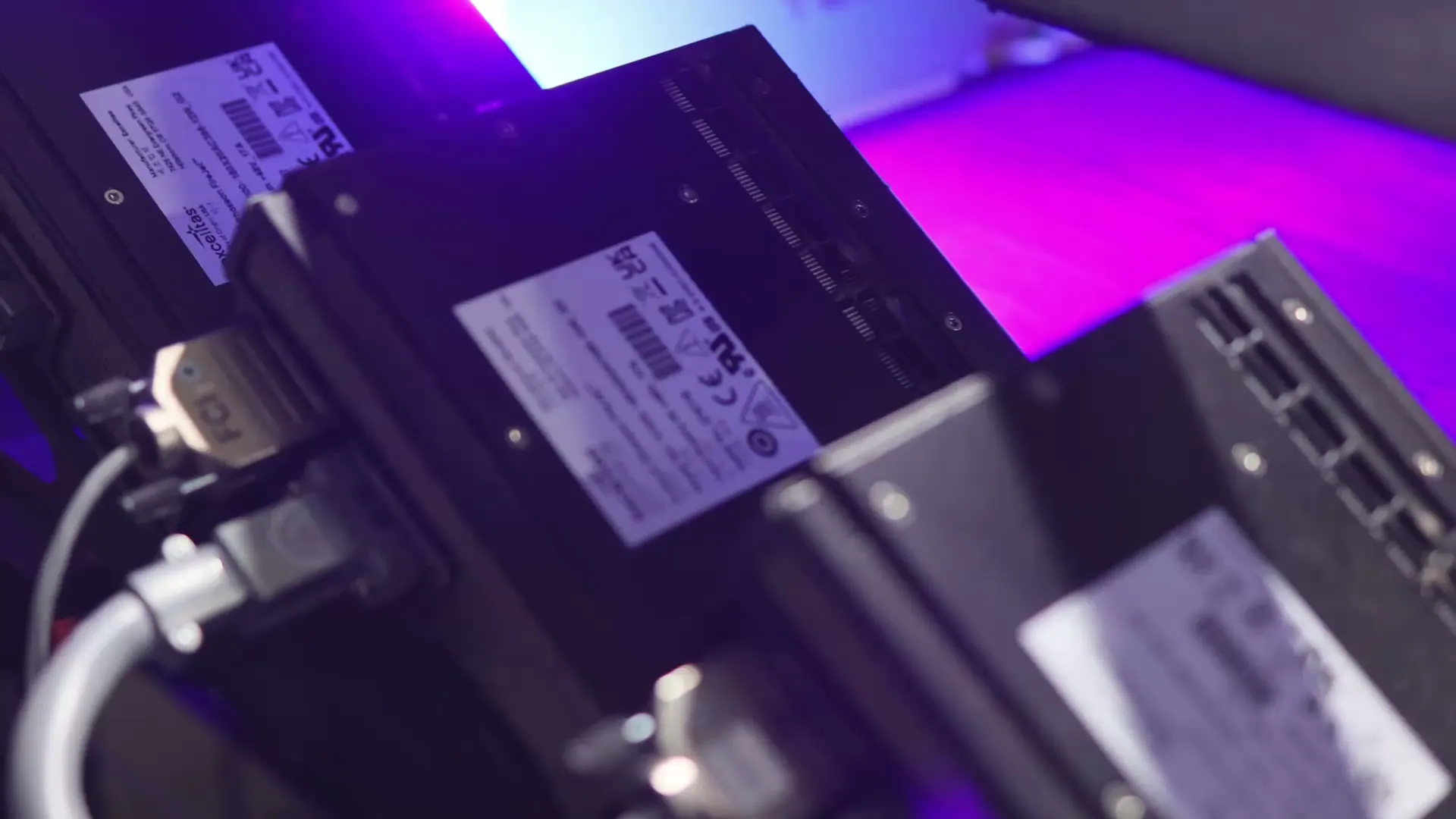
Marking in sawmill environments used to be limited to low-resolution “dot printing” (with poor readability and a limited amount of information) or labels that slow down the production rate. Labels cause unnecessary, constant stoppages to change rolls and adjust mechanical arms, and labels come off or stick together during production and transport.
With modern UV-curable inkjet technology, all of this is replaced by high-resolution, permanent stamps and codes directly on wood or packaging material.
The process step by step
- The timber passes. The boards are conveyed on a roller conveyor or chain conveyor at full production speed, with no slowing down required.
- A sensor detects. A photocell and an encoder register the board’s position and speed and trigger printing at exactly the right moment.
- Ink is applied. The piezo printhead jets microscopic droplets of UV ink: text, barcodes, QR codes and graphics in high resolution.
- A UV lamp cures. Immediately after printing, the ink passes a UV LED lamp. The ink polymerises instantly and is dry and permanent in milliseconds.
Benefits of UV inkjet
- Instant curing. The UV ink cures in milliseconds: no spreading, no waiting times, no mess, no risk of smearing during further handling.
- High resolution. 360 DPI enables sharp barcodes, QR codes, 2D codes and detailed text in black and white that is crisp and machine-readable.
- Durable marking. UV-cured ink is resistant to moisture, UV light, abrasion and chemicals. The marking stays in place throughout the entire chain.
- No loss of production rate. Prints at speeds of up to 200 m/min (NoLabel® SOLO up to 300 m/min with reduced blackness) and adapts to the existing line speed without creating a bottleneck.
- No labels. Eliminates paper, plastic, adhesive and mechanical applicator arms. Less waste, fewer stoppages, lower operating costs.
- Flexible content. Every print can be unique, with variable data, serial numbers, date stamps and traceability codes without changeover.
Comparison of marking technologies
| Dot matrix (DOD) | Labels | UV inkjet | |
|---|---|---|---|
| Resolution | Very low (up to 32 dots) | High (300 DPI) | High (up to 360 DPI) |
| Barcode / QR | Very limited | Yes | Yes, directly on wood in black and white for high contrast |
| Durability | Medium–high (fades, bleeds) | Very low (comes off) | High, permanent |
| Production speed | High | Low, plus stoppages for changes | Very high: up to 200 m/min, 300 m/min with reduced blackness |
| Consumables | Ink and solvent | Labels + ribbon + adhesive | Ink only |
| Maintenance / stoppages | Low–medium | High (mechanical) | Low, no moving parts |
| Variable content | Limited | Limited | Fully variable |